
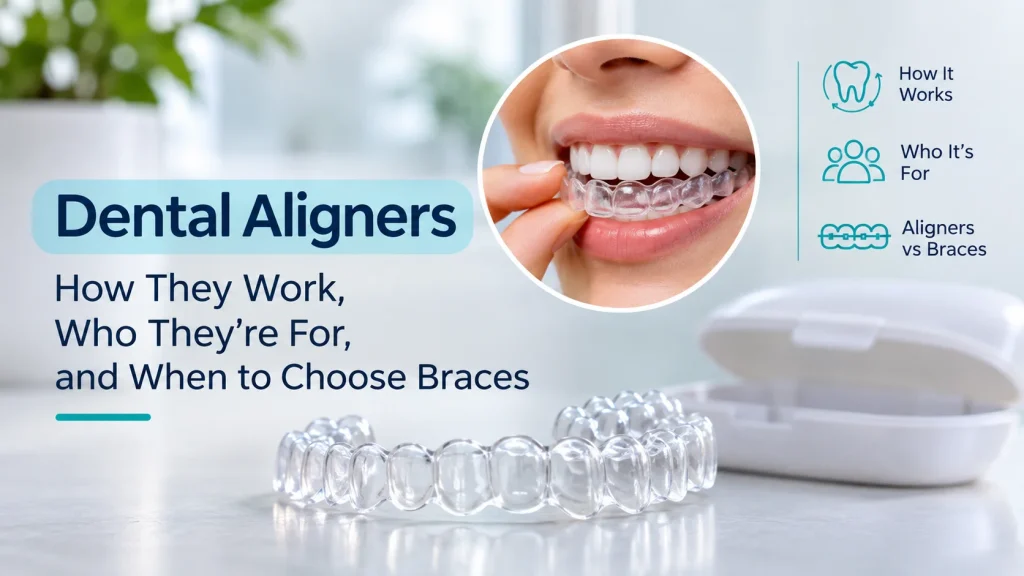
Dental aligners are transparent, removable orthodontic trays designed to gradually move teeth into their desired positions. They offer an alternative to traditional braces for people who want to improve their smile without wearing visible metal brackets and wires.
Each set of aligners is custom-designed to apply controlled pressure to specific teeth. You typically wear one set for a prescribed period before moving on to the next set in the treatment series.
When used under professional supervision, clear aligners can help address several common dental alignment concerns, including mild to moderate crowding and gaps between teeth.
However, successful treatment requires consistency. Aligners need to be worn for the recommended number of hours every day, and skipping wear time can affect your treatment progress.
How Do Dental Aligners Work?
Dental aligners work by applying gentle, continuous pressure to selected teeth, gradually guiding them into their planned positions.
The treatment generally begins with a dental examination and a digital scan of your teeth. This information is used to create a customised 3D treatment plan that maps the expected movement of your teeth throughout the process.
Here is what you can expect during treatment.
1. Initial Dental Examination and Digital Scan
Your dentist or orthodontist first examines your teeth, gums, and bite to determine whether clear aligners are appropriate for your dental condition.
A digital scan or impression of your teeth is then taken to create an accurate 3D model of your mouth.
Any existing dental concerns, such as cavities or gum disease, should be addressed before starting orthodontic treatment.
2. Personalised Treatment Planning
Using the digital model, your orthodontist plans how each tooth should move throughout the treatment.
The treatment plan determines the sequence of aligners required to achieve the intended alignment. Depending on your dental condition, certain preparatory procedures may also be recommended to create sufficient space for tooth movement.
3. Placement of Attachments, If Required
Some patients may need small, tooth-coloured attachments bonded to selected teeth.
These attachments help the aligners grip specific teeth and achieve certain movements more effectively. They are particularly useful when teeth need to rotate or move in directions that require additional control.
Not every patient requires attachments. Their use depends on your individual treatment plan.
4. Wearing Your Aligners
Clear aligners are generally recommended to be worn for approximately 20–22 hours a day, depending on your orthodontist's instructions.
You can remove them while eating, drinking anything other than plain water, brushing, and flossing.
Maintaining proper hygiene is essential. Clean your teeth before putting your aligners back in, and clean the trays as instructed by your dental professional.
Avoid drinking sweetened beverages with your aligners in place, as trapped sugars can increase the risk of tooth decay.
5. Completion and Retention
Once your active aligner treatment is complete, your orthodontist will assess the final tooth positions.
Retainers are generally recommended after orthodontic treatment to help maintain the results. Without proper retention, teeth may gradually shift towards their original positions.
Following your orthodontist's retention instructions is an important part of maintaining your new smile.
Dental Aligners vs Traditional Braces: What's the Difference?
Both clear aligners and traditional braces are orthodontic treatments designed to correct tooth alignment and improve your bite.
However, they differ in appearance, convenience, maintenance, and suitability for different dental conditions.
| Feature | Clear Aligners | Traditional Braces |
|---|---|---|
| Appearance | Transparent and discreet | Metal or ceramic brackets are visible |
| Removable | Yes, can be removed when required | No, fixed throughout treatment |
| Eating | Removed during meals | Certain foods may need to be avoided |
| Cleaning | Easier to brush and floss normally | Requires additional cleaning around brackets |
| Treatment Responsibility | Requires consistent patient compliance | Remain fixed and are managed by the orthodontist |
| Suitability | Suitable for selected mild to moderate alignment concerns | Can address a wider range of orthodontic conditions |
Which Option Should You Choose?
Clear aligners may be suitable if you have mild to moderate alignment concerns, prefer a discreet treatment option, and can consistently wear removable trays.
Traditional braces may be more appropriate when your dental condition requires more complex tooth movements or significant bite correction.
The right treatment depends on your teeth, jaw alignment, oral health, and individual orthodontic requirements.
An orthodontic consultation can help determine which option is most appropriate for your needs.
Who Is a Good Candidate for Dental Aligners?
Clear aligners can be an effective orthodontic option for people with certain types of tooth alignment concerns.
You may be a suitable candidate if you have:
- Mild to moderate dental crowding.
- Small gaps between your teeth.
- Minor alignment issues involving front teeth.
- Teeth that have shifted after previous orthodontic treatment.
- A preference for a discreet alternative to traditional braces.
However, clear aligners are not suitable for every orthodontic condition.
When Might Traditional Braces Be a Better Option?
Your orthodontist may recommend traditional braces or a combination of orthodontic treatments if you have:
- Significant bite problems, such as a pronounced overbite or underbite.
- Teeth that require substantial rotation or complex movements.
- Severe dental crowding or alignment issues.
- Active gum disease that needs treatment before orthodontic correction.
- Difficulty consistently wearing and maintaining removable aligners.
A proper clinical examination is essential before choosing any orthodontic treatment.
It is also important to avoid starting treatment without professional supervision. A digital scan alone cannot identify every underlying dental concern, such as cavities, bone loss, or infections affecting the tooth roots.
Do Dental Aligners Hurt?
Some discomfort is normal when starting a new set of dental aligners.
You may experience mild pressure, tightness, or a dull aching sensation as your teeth gradually adjust to their new positions.
This discomfort is generally temporary and may be more noticeable during the first few days after switching to a new set of aligners.
Many patients find the smooth plastic surface more comfortable for their cheeks and gums compared with traditional brackets and wires.
However, experiences can vary from person to person.
When Should You Contact Your Dentist?
Sharp pain, persistent discomfort, or aligners that do not fit properly should not be ignored.
If you experience these issues, contact your dental clinic for an assessment rather than attempting to adjust the aligners yourself.
How Long Does Dental Aligner Treatment Take?
The duration of clear aligner treatment depends on several factors, including the complexity of your dental condition, the number of movements required, and how consistently you wear your aligners.
Some mild alignment cases may be completed in approximately six months, while more complex cases can take a year or longer.
Your orthodontist will estimate the expected treatment duration after examining your teeth and preparing your treatment plan.
Factors That Affect Treatment Duration
1. Complexity of Your Dental Condition
Minor spacing and crowding concerns generally require less treatment than complex bite and alignment problems.
2. Consistency in Wearing Aligners
Aligners need to be worn for the recommended number of hours each day. Frequently removing them or forgetting to wear them can delay tooth movement.
3. Number of Aligner Sets Required
Each treatment plan includes a specific sequence of aligners. Additional aligners may sometimes be required to refine tooth positions.
4. Regular Dental Follow-Ups
Scheduled appointments allow your orthodontist to monitor progress and make adjustments when necessary.
Following your treatment instructions and attending regular check-ups can help keep your orthodontic journey on track.
Getting Dental Aligners in Cuttack
Choosing the right orthodontic treatment starts with understanding your dental condition and treatment goals.
At Dental Help, Cuttack, aligner consultations are conducted with Dr. Mitali Mishra. During your consultation, your teeth, gums, and bite will be evaluated to determine whether clear aligners are suitable for you.
Depending on your dental condition, you may be advised to consider clear aligners, traditional braces, or other dental procedures before beginning orthodontic treatment.
Bringing any previous dental X-rays, reports, or photographs of your teeth can also help during your consultation.
If you are considering clear aligners to improve your smile, schedule a consultation with Dental Help.
Dental Help
Address: Canal Road, Ranihat, Cuttack, Odisha – 753001
Phone: 94371 21631
You can also visit our contact page to schedule your appointment.